News
More Than an internship: Experiencing Conservation in Action at Reef Conservation
What does it really mean to work in conservation? For many students, an internship offers the first opportunity to move beyond textbooks and discover how environmental action takes shape in the field. At Reef Conservation, interns do not simply observe our work; they become part of it.
Through the experiences of Jules Vermaase, a Marine Ecology student at the Wageningen University and Research in Netherlands, and Nevin Mariadhasan, who is pursuing a master's degree in international relations at the University Clermont Auvergne in France, two very different academic paths have converged around a shared purpose: contributing to the protection and restoration of Mauritius’ marine ecosystems.
Turning knowledge into action
For Jules Vermaase, joining Reef Conservation was an opportunity to apply the knowledge gained during his studies while developing practical skills in coral restoration.
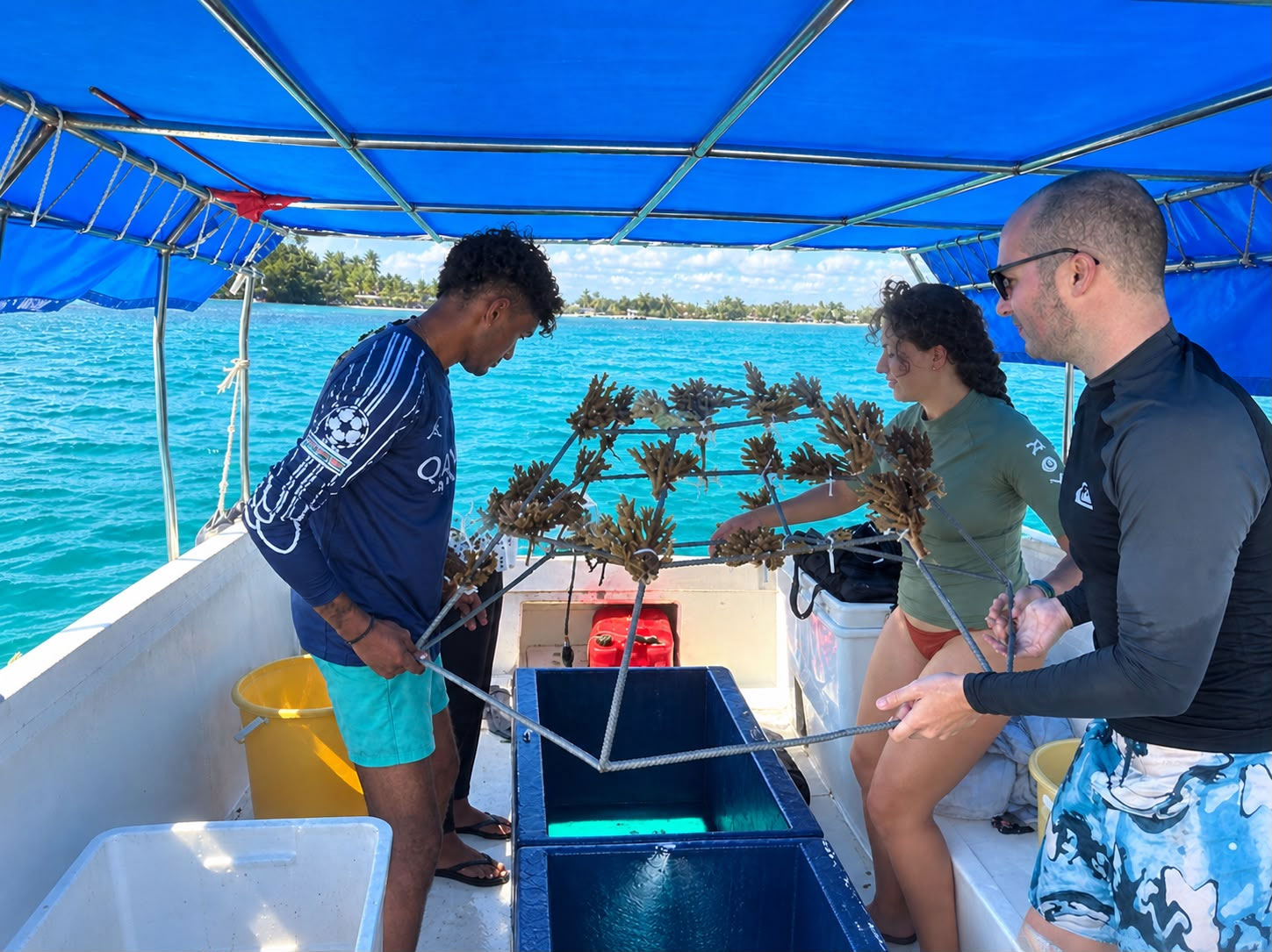
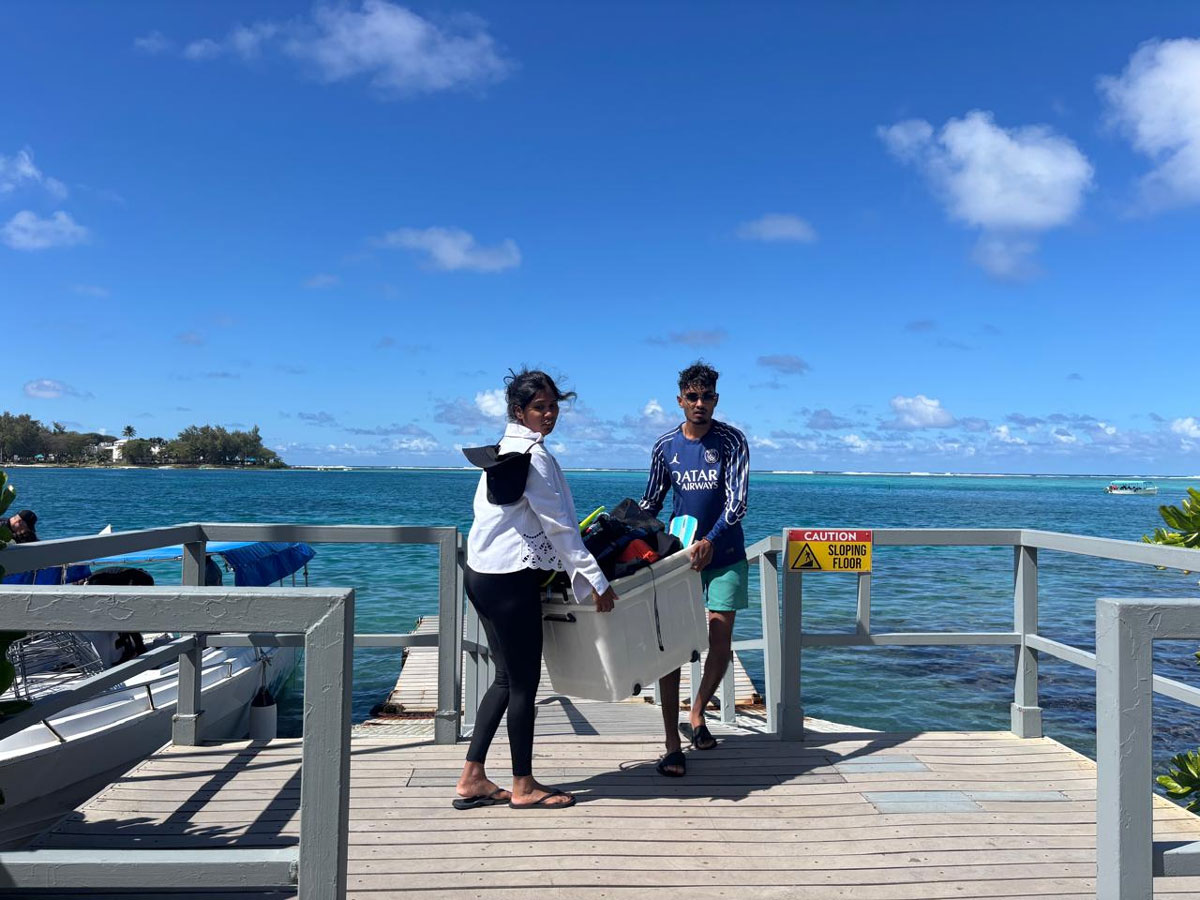
His internship regularly takes him to the waters of Pointe Jérôme, where Reef Conservation’s coral nurseries are located. Equipped with masks, snorkels and tools, interns work alongside our team to remove algae from the ropes and structures supporting growing coral fragments.
These maintenance activities may appear simple, but they are essential. Keeping the nursery structures clean allows the corals to grow under better conditions before they are eventually returned to the reef. “Working underwater gives us the opportunity to get a close look at the corals and the many small organisms living around the nurseries,” Jules Vermaase explains.
He has also participated in nursery stocking, from collecting corals at donor sites to preparing and attaching fragments to underwater ropes. By taking part in each stage, he has gained a clearer understanding of how restoration begins and of the sustained care required before corals can be out planted.
For Nevin, coral restoration was an almost entirely new field. Coming from an International Relations background, he admits that he initially felt apprehensive when he arrived at our South Office in Riche-en-Eau. That uncertainty, however, quickly gave way to curiosity. “The team welcomed me, took the time to explain how the organisation works and made me feel comfortable from the start,” he recalls.
His experience demonstrates that conservation is not reserved exclusively for students with a scientific background. Motivation, curiosity, and a willingness to learn can also open the door to meaningful involvement.
The rewarding moment of outplanting
For both interns, coral outplanting has been one of the most memorable aspects of their placement. Once coral fragments have grown sufficiently in the nurseries, they are prepared on spider frames and transported to restoration sites in the Blue Bay Marine Park. The frames are then carefully placed onto the reef, giving the corals an opportunity to continue developing in their natural environment.
Outplanting is Jules Vermaase’s favourite field activity. Beyond the work itself, these trips allow him to experience the richness of Mauritius’ marine environment, with occasional encounters with rays, barracudas and turtles.
For Nevin, the activity carries a particularly strong meaning. “It is the moment when the care given to coral fragments in the nursery becomes visible on the reef,” he says. “Helping to prepare and deploy the frames gave me a direct sense of contributing to reef recovery.”
Yet the work does not end once the corals have been returned to the reef. Restored areas still require monitoring, maintenance, and patience. This long-term commitment is one of the most important lessons offered by the internship: conservation is not a single intervention, but a continuous process.
Behind every field trip lies science
Although working at sea is often the most visible and exciting part of marine conservation, much of the work continues back at the office.
Jules Vermaase and Nevin have both contributed to activities such as analysing underwater footage, supporting report writing and developing educational games and activities to help people of different ages better understand reef ecosystems.
Nevin has worked with videos collected during fish and coral monitoring activities, including data from Bel Ombre. Identifying and counting fish accurately requires concentration, repeated viewing and close attention to detail. Analysing coral and substrate categories along underwater transects presented another new challenge.
With guidance from our team, he gradually became more confident in applying these scientific methods. “I realised that reef protection does not stop when a field trip ends,” he explains. “Data are essential for following changes, evaluating restoration activities and deciding what should happen next.”
This combination of fieldwork, scientific monitoring, analysis, reporting and awareness reflects the reality of conservation. Every observation must be documented, every intervention assessed and every lesson shared if long-term action is to remain effective.
For Jules Vermaase, the coral nurseries have also become part of his university research. By studying how fish use these structures, whether as permanent habitats or temporary shelters, he is exploring the wider ecological role that nurseries may play for local marine fauna. Our team has supported him with the tools and guidance needed to record footage and conduct assessments.
Learning from people as well as nature
An internship at Reef Conservation is also a human experience. Interns work alongside staff members, field technicians, and community participants who bring different forms of knowledge to the same mission.
Both Jules Vermaase and Nevin highlight the support they have received from their colleagues and the welcoming atmosphere within the organisation. Whether at sea or in the office, collaboration remains central to the work.
They also share a special appreciation for Christophe, our skipper and field technician, whose experience and knowledge of Mauritius’ marine environment enrich every field trip. From identifying fish and corals to understanding lagoon conditions, his expertise offers interns a form of learning that cannot be found in a textbook.
For Nevin, seeing staff members, interns and local participants enter the water and work towards a common objective has reinforced the importance of collective action. Long-term conservation succeeds when scientific knowledge, field experience and community involvement come together.
An experience that changes perspectives
Jules Vermaase’s and Nevin’s journeys show that an internship can be much more than a professional requirement. It can be an opportunity to acquire practical skills, contribute to meaningful projects and better understand the dedication required to protect the natural environment.
“I am very happy that I chose Reef Conservation for my internship,” Jules Vermaase says. “The experience has given me a much better understanding of what conservation work looks like in practice.”
Nevin shares a similar reflection. Before joining Reef Conservation, he viewed coral conservation mainly as practical work conducted at sea. He now understands it as a complete process connecting restoration, scientific monitoring, data analysis, reporting, awareness and community participation.
Their experiences also remind us that there is no single pathway into conservation. Whether your background is in marine science, international relations, communication, education or another field, your knowledge and enthusiasm can contribute to protecting our ecosystems.
Would you like to experience conservation in action? Stay tuned on our website and follow Reef Conservation on social media to discover more about our projects and activities. If you, or someone you know, would be interested in joining us as an intern or volunteer, do not hesitate to contact us.
Together, we can learn, act and make a meaningful contribution to the protection of Mauritius’ natural heritage.
© Reef Conservation. All Rights Reserved. Designed by Design Element